


Showing posts with label Volvo. Show all posts
Showing posts with label Volvo. Show all posts
Volvo P1800
Lexus launch in India confirmed
 Toyota has officially confirmed that it will introduce the Lexus brand in India by 2013. The Japanese carmaker has been evaluating the feasibility of its luxury brand in India for several years now and has finally decided to go ahead with the launch. �We have been watching India with keen interest and we are happy to announce that we will bring Lexus to India in 2013� confirmed Yukitoshi Funo, executive vice-president of Toyota Motor Corporation.
 The Lexus range will be sold through dedicated dealerships, though several Toyota dealers are likely to take up the franchise to take advantage of their service set up that requires common equipment for both brands. However, Toyota will take a very cautious and diligent approach to appointing dealerships. �We would rather have a few, quality dealerships than a large number of mediocre outlets� said Funo who also emphasised that he wanted to differentiate Lexus from its German rivals. Last month Kazuo Ohara, who oversees the Lexus brand globally, made a visit to India and gave the green light after intense market research, which included studying the dealer and service outlets of other brands.
 Toyota plans to follow a top-down strategy and the initial plan is to introduce the LS saloon and RX SUV, both premium luxury models. This is likely to be followed by the GS executive luxury saloon which competes directly with the E-class and 5-series.
The company will initially bring the Lexus range as imports or completely built-up (CBU) units to test the market before considering local assembly. �We need consider local production to compete with the others in the market, but this is still being studied,� said Funo. It is likely that the compact IS models will be locally assembled in time.

 The initial feedback and market studies for the Lexus brand have been very encouraging. �The Indian consumers� awareness of Lexus is quite surprising and much more than we anticipated,� said Funo. However, the challenge will be to price the cars competitively, especially since Lexus will initially import cars and will be at a cost disadvantage in comparison to rival luxury brands that locally assemble and hence pay lower duty. Also, there is no diesel engine in the Lexus range which could be another disadvantage. However, Lexus will introduce its hybrid technology, which could click with customers looking for the ultimate in refinement.
New Volvo V60 Sports Wagon: 2011 S60 gets Practical

Revealed ahead of its Paris Motor Show debut, the all-new Volvo V60 is the estate version of the recently launched 2011 S60 sedan. Aimed almost squarely at European buyers as Volvo projects that "no less than 90 percent" of the annual V60 production of 50,000 cars will find a home in Europe, the sporty-looking estate model will go on sale this fall.
 Volvo describes the low slung V60 as a sports wagon with a coupe-like roofline. "The typical sports wagon customer is an S60 buyer who would like some extra space and flexibility, but without the slightest compromise on sporty design and exciting driving properties," says Volvo Cars President and CEO Stephen Odell.
However, Volvo's focus on looks come with a cost as the V60's boot space is a mere 430 liters with the rear seats up. That's compared to 460lt of the BMW 3-Series Touring, 485lt of the Mercedes C-Class Estate and 490lt of the Audi A4 Avant. The car will come equipped with a 40/20/40-split rear seat and the fold-flat front passenger seat.
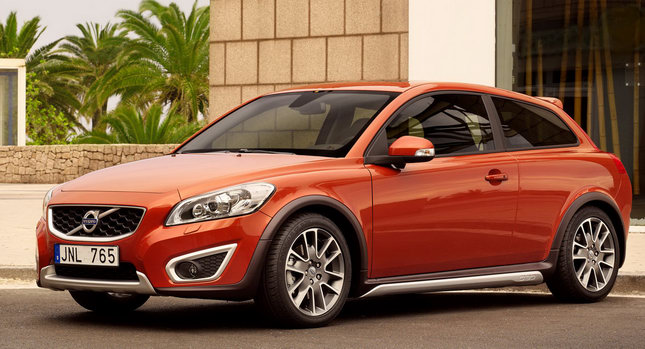
Volvo C30

Limited Edition Volvo V70 T6 AWD R-Design with 325HP by Heico Sportiv

Heico Sportiv has been putting together more stylish and powerful Volvos for over a decade. Now, the tuning firm has once again joined forces with Volvo to create a special edition version of the V60 T6 estate for the German market. It goes on sale this summer with a hefty �70,193 [about US$87,000] price tag in a limited run of just 100 copies, all in a metallic sapphire black shade.
This V70 T6 AWD R-Design is motivated by the firm's 3.0-liter turbocharged inline-6 upgraded with a recalibrated ECU and a sport exhaust system that cranks out 325HP and a maximum torque of 460 Nm / 339 lb-ft, a jump of 21HP and 20Nm over stock. The engine is matched to a six-gear automatic gearbox with geartronic function.
Worldwide Recall for 2010-2011MY Volvo C30, S40 and V50
Volvo announced on Monday that it will recall 29,299 cars worldwide of which 536 were sold in the USA and around 6,700 in Britain, over a problem with the gearshift lever. The cars in question are certain 2010-2011MY C30s and 2010MY S40 and V50 models equipped with 6 speed manual transmissions.
Frankfurt 2011: Volvo �Concept You�

Volvo is China's Swedish takeaway. A year on from its acquisition by a consortium of Chinese money-men, things are now getting serious. Sales are up 21 per cent in the first eight months of the year, the brand - beloved of San Francisco bay-area architects - is the fastest-growing in the US (whatever fastest-growing means), and a factory in Chengdu is due to open before the year's end. CEO Stefan Jacoby is also making very bullish noises. Given that Volvo's stand was being hastily extended on Monday - just 12 hours before Frankfurt show press day - to annex the space originally booked by a sadly absent Saab, we should be glad he's got something to be bullish about.
The Frankfurt hoopla was focused around �Concept You', which evolves some of the ideas set out by the �Concept Universe' earlier this year, and posits a new full-size premiumVolvo luxury car. Those with long memories or elderly Scandinavian relatives will spot the debt the new car owes to the PV544, specifically in the curious but effective curving nose treatment and grille. Elsewhere, the body-sides and glass area are Jag XJ - though the C-pillars are tidier - and the rear end has shades of Audi A7. A little derivative, then, but beautifully done.
It's equally good inside. Suicide doors - regular show car stuff, generally chosen to show off a car's interior - open onto a cabin that blends a stunning mix of wood, leather and suede. The driver's seat and the rear compartment are trimmed in contrasting materials, the seats �float', and the overall effect is a tasteful reinvention of Swedish design tropes guaranteed to get Wallpaper magazine readers elegantly excited. Not sure what they'll make of it in Beijing, though.
The main instrument display is effectively an iPad which uses touch-screen technology to brilliantly simple effect, and ushers in the era of jet-fighter tech where the driver's retina will trigger commands. There's another touch-screen in the back, and sitting between the seats - for no apparent reason other than it's another Swedish design �icon' - is a �28,000 Hasselblad camera.
The �You' - great name guys - is underpinned by Volvo's new Scalable Platform Architecture, which allows for full electrification, and will form the basis of all future models. None of which - get this - will use anything larger than a four-cylinder engine. Extra power will come instead from �flywheel drive', a KERS-style energy capture system that generates another 80bhp or so. Volvo also claims that 90 per cent of the first �SPA' car to be launched will use all-new components, and there is a definite sense of being liberated from the giant Ford matrix.
As is design director, the near-legendary Brit Peter Horbury, who returns to Gothenburg after a lengthy sojourn in Dearborn. Horbury helped define Volvo's design vision in the 1990s, and he's back to do it all over again. �It's a whole new challenge,' he says, �and a completely different world. My new boss has lots of ideas...' Apparently, some of these reach Peter in the form of poetry.
TG.com will be catching up with Horbury soon. Not just a great car designer, this is a man who has participated in lively nights out with Iron Maiden. But that's another story...
Volvo Plug In Hybrid By 2012 Review and Spec

Volvo Plug In Hybrid By 2012
Volvo has announced today that it will introduce its first plug-in hybrid by 2012. Pure electric power from the battery will cover the daily transport needs of 75 percent of European drivers. For longer distances, an efficient diesel hybrid engine automatically takes over. The combined range is about 1200 kilometres. Carbon dioxide emissions will average out at 49 grams per kilometre, with fuel consumption of 1.9 litres per 100 km.
"The new Volvo plug-in will be a truly enjoyable car to drive, featuring Volvo's high safety and comfort standards. At the same time, CO2 levels and fuel consumption will be as low as half that available on the market today." says Stephen Odell, President and CEO of Volvo Car Corporation.
[Source: Volvo ]


Volvo Plug In Hybrid By 2012
Volvo Car Corporation to put plug-in hybrids on the market in 2012Volvo is introducing a series-produced plug-in hybrid as early as 2012. Pure electric power from the battery will cover the daily transport needs of 75 percent of European drivers. For longer distances, an efficient diesel hybrid engine automatically takes over. The combined range is about 1200 kilometres. Carbon dioxide emissions will average out at 49 grams per kilometre, with fuel consumption of 1.9 litres per 100 km.
Volvo is convinced that in the future, customers will continue to want safe, comfortable cars with good driving properties and generous load-carrying ability. Irrespective of whether they are powered by electricity or other fuels.
Plug-in hybrids are an attractive car type offering the user the best from both electric power and conventional drivelines: extremely low fuel consumption and CO 2 levels, combined with a long range and high performance.
"The new Volvo plug-in will be a truly enjoyable car to drive, featuring Volvo's high safety and comfort standards. At the same time, CO 2 levels and fuel consumption will be as low as half that available on the market today." says Stephen Odell, President and CEO of Volvo Car Corporation.
Volvo plug-in hybrid advantages:
- Fuel consumption, running costs and CO 2 emissions are very low
- The car is a "normal" Volvo, with all its customary good properties
- It is conveniently recharged at home via a regular wall socket
- It is an enjoyable car to drive, offering high performance
Electricity is highly suited as a car fuel. The electric motor has a high efficiency rating and consumes about one-fifth as much energy as a corresponding engine running on fossil fuel. Volvo's plug-in hybrid cars will be propelled by a robust electric motor that receives its power from a lithium-ion battery. What is more, additional electricity is generated every time the car brakes.
The battery is conveniently recharged at home via a regular wall socket. Electricity as a fuel is far cheaper than petrol or diesel, which results in low operating costs. The battery will take about five hours to recharge.
The range will be about 1200 kilometres, just like in a conventional diesel car. It will be able to be driven up to 50 kilometres on pure electric power and when running on the battery, emissions from the exhaust pipe will be non-existent. If the battery is recharged using electricity from renewable sources, the net emission of CO 2 will be close to zero, even in a lifecycle perspective. Volvo's dealers will offer customers who buy a plug-in hybrid a special contract for the supply of renewable energy. This agreement has been created in cooperation with the company's partner, Swedish electricity supplier Vattenfall.
Efficient diesel engines as a complement
As a complement to the electric motor, one of Volvo's fuel-efficient diesel engines will also be fitted under the bonnet. It will be optimised to run on renewable synthetic diesel and will meet the tough forthcoming exhaust emission requirements.
The diesel engine can be run separately or in combination with the electric motor for optimal power and energy utilisation. For example, the diesel engine can support or replace electric power at high speeds or when the battery charge drops, while the electric motor can offer additional torque at low engine revs. Being able to combine these two power sources makes it possible to offer high performance and trouble-free use by the owner.
Most car trips cover short distances, to and from work. This means that the forthcoming Volvo plug-in hybrid will cover the transport requirements of most people. For longer distances, the diesel engine starts up automatically, giving the car the same properties and range as a conventional diesel car.
According to the standardised NEDC certification driving cycle, CO 2 emissions from Volvo's plug-in hybrid will be lower than 50 grams/kilometre. Cars with emissions below 50 grams of CO 2 /kilometre will probably have the most favourable incentives in many European countries. In addition to tax relief, these countries will offer a discount of about 5000 euros on the purchase price, a move that is expected to set the standard for the rest of Europe too.
"We are focusing strongly on plug-in hybrids in order to meet the demands for low CO 2 emissions and to provide sustainable road transportation. We naturally expect that the relevant authorities will offer subsidies to boost developments, speeding up the creation of a market for this type of car," says Stephen Odell.
Today's electricity capacity covers requirements
Plug-in hybrids consume less electricity than most people believe. The fact is that a single medium-sized wind-power station can produce renewable electricity to cover the annual consumption of 1000-2000 plug-in hybrids in normal use. Even a large number of plug-in hybrids on the roads would be able to be supplied within the framework of the electric grid's existing capacity. If 15 percent of Europe 's cars consisted of plug-in hybrids, this would mean that total electricity requirements would only increase by between 1 and 3 percent.
Through simple household energy savings, for instance by switching off the PC and TV overnight and using low-energy bulbs, the total energy requirement would probably be able to be kept at current levels. To put this into perspective, the energy-efficiency improvements that Volvo Cars has implemented in its factories in Ghent and G�teborg over the past four years correspond to the annual electricity consumption of 15,000 plug-in hybrid cars.
Plug-in hybrids - market potential
The purchase price of a plug-in hybrid is expected to be considerably higher than for a conventional diesel car since the batteries are still expensive. Fuel costs on electric power will be about one-third compared with driving on diesel, and this partially compensates for the higher purchase price, although not fully.
Volvo Cars assesses that plug-in hybrids will be commercially viable for certain customer categories in 2012, gradually widening in appeal as battery price and performance continuously improve.
Skipping stages in technological development
For the time being, Volvo Cars is postponing its plans to produce what is known as a full-hybrid based on a diesel engine.
The strategy that Volvo is adopting to start series-producing plug-in cars as early as 2012 is to exploit already existing, tried and tested platform architecture for major components such as the body and engine. Instead of waiting for an entirely new generation of car models, the company is saving time by using innovative solutions to install the battery and electric motor beside a conventional driveline. In this way, the new technology will get out to car buyers that much sooner.
Plug-in hybrids the result of industrial cooperation
In January 2007, Volvo Cars and energy supplier Vattenfall launched a joint project with the aim of testing and developing plug-in technology. A new company was founded, V 2 Plug-in-Hybrid Vehicle Partnership, as a result of this cross-border initiative.
The formation of the joint company with Vattenfall creates entirely new preconditions for developing next-generation green technology in a highly efficient way. Working in partnership is something that the company regards as an absolute necessity in the drive towards a sustainable future.
Volvo XC70 2012 Review and Spec

Volvo XC70 2012
The third generation Volvo XC70 2012 has been upgraded with a number of features including the latest user-friendly Volvo Sensus infotainment system, enhanced technology that makes driving even safer and more comfortable, and refined drivelines that offer higher performance and lower fuel consumption.
[Source: Volvo]


Volvo XC70 2012
The third generation Volvo XC70 is more refined than ever. A comfortable and luxurious appearance has been combined with top-class flexibility and an expressive design. The XC70 is a sophisticated and elegant car for an active urban life. Come the weekend and it transforms into a rugged partner for all kinds of exciting adventures.
The XC70 has been upgraded with a number of features including the latest user-friendly Volvo Sensus infotainment system, enhanced technology that makes driving even safer and more comfortable, and refined drivelines that offer higher performance and lower fuel consumption.
EXTERIOR
Rugged look
The model has a unique soft nose. This is characterised by a larger grille and headlamps. The dark-coloured body panels provide an exclusive, rugged impression, clearly signalling the car's dynamic capabilities. ?Moving to the side, the contrasting protective sections are supplemented with a chrome moulding at the bottom of the doors. The pronounced wheel housings are another design feature, contributing to the capable appearance. A number of design elements, like the framed side windows and the distinct shoulders, create a genuine estate car profile.
The tailgate's upper section has a sportier forward-leaning stance. The tailgate overlaps the tail lamps, providing an even wider opening. The glass goes further down at the sides, enhancing rear view. The rails are integrated into the A-pillar mouldings.
A new exterior features in Model Year 2012 is the redesigned headlamps.
Exterior colours
The following exterior colours are available for the Volvo XC70:
Flamenco Red metallic 702
Black Stone solid 019
Ice White solid 614
Silver metallic 426
Black Sapphire metallic 452
Caspian Blue metallic 498
Caper Green metallic 493
Electric Silver metallic 477
Ember Black metallic 487
Savile Grey metallic 492
Seashell metallic 484
INTERIOR
Volvo Sensus - refined infotainment
Volvo Sensus is an excellent example of how Volvo Cars refines the driver environment. All information is presented on a five-inch or seven-inch colour screen in the upper part of the centre stack. The screen is positioned high up to make it easy for the driver to keep his or hers eyes on the road. All the functions can be controlled via buttons built into the steering wheel or via touch buttons located just below the colour screen.
If the customer chooses a multimedia audio system, Volvo Sensus comes upgraded with the larger seven-inch screen that also displays information and images from the navigation system, phone, reversing camera, panorama camera, DVD player, digital TV and so on.
The Bluetooth connection has been upgraded to allow not only hands-free phone conversations but also music streaming from a preferred Bluetooth enabled portable music player. Volvo is actually the only brand to offer Bluetooth music streaming throughout the entire vehicle range.
Keep in touch via mobile application
New is also a mobile application that makes sure that the driver can stay in touch with the parked car via an iPhone or Android smart phone. The mobile application is an extension of Volvo On Call, which is presently available in 12 European countries plus Russia and Brazil.
Now, the system has been reinvented. Owners of all new Volvos from Model Year 2012 with Volvo On Call can download the new application that opens up a range of connectivity possibilities. The mobile app is free and downloaded via the iPhone and Android application stores. The app is designed to offer the owner an intuitive, easy-to-use relationship with the car from a distance.
Scandinavian design at its best
The interior of the XC70 is an example of Scandinavian design at its best. Every little detail has been designed with a one hundred percent focus on both clean form and intelligent functionality. Comfort in the front seat features superb seats and ergonomically designed instruments - including an elegant, super-slim centre stack and an audio system of absolute world class.
In addition to Sandstone Beige and Anthracite Black there is an Espresso Brown option where the warm dark colour of the seats, door panels and instrument panel contrasts with the sand-coloured detailing of the rest of the interior trim.
There is also a new Blond highlight colours for the upholstery as well as a new three-spoke steering wheel, enhanced d�cor inlays and redesigned interior lighting.
The integrated dual child booster cushions can be adjusted in two steps and the 40/20/40-split rear seat has integrated seat belts. The lightweight design of the rear backrest and the simple folding mechanism are other examples of improved functionality for passengers. Electrically folding rear seat headrests are also available in the XC70.
Loading space under the floor
Everything and everyone rides in first class. Even the luggage compartment and all its options and accessories have been designed to meet the very highest demands on luxury and intelligent functionality. Among the smart details in the luggage compartment is a storage space under the floor that is locked when the tailgate is shut. A power tailgate is an option.
CHASSIS
Controlled ride
The car has been developed and balanced to give a first-class driving experience, based largely on pliant ride and secure road holding allied to high stability. Stability is particularly important when driving with many passengers and a lot of luggage.
The car has been developed and balanced to give a first-class driving experience, based largely on pliant ride and secure road holding allied to high stability. Stability is particularly important when driving with many passengers and a lot of luggage.
Thanks to the design of the body structure and the optimised use of different grades of high-strength steel, torsional rigidity was increased by no less than 15 percent compared to the previous XC70 model. The chassis technology has been further developed to provide even more stable and more controlled road manners. A lot of effort has also gone into features such as the suspension system and engine installation to ensure high-class comfort.
DSTC is standard
DSTC (Dynamic Stability and Traction Control) is standard. This is a stability-enhancing system that when necessary reduces engine torque and applies carefully calculated braking power to reduce the risk of a skid.
Active chassis with Four-C - and three choices
The car can be optionally specified with an active chassis based on Volvo's Four-C technology. It is an advanced self-regulating chassis system that uses a number of sensors to continuously monitor the car's behaviour. The dampers are adjusted to suit the current driving conditions in mere fractions of a second.
All Wheel Drive with Instant Traction
Several variants of the Volvo XC70 come All Wheel Drive. Using an electronically controlled hydraulic clutch, the AWD system distributes drive between the front and rear wheels to ensure the best possible road grip in all situations. The system features Instant Traction, which shifts drive at lightning speed from the front to the rear wheels when starting on a slippery or loose surface.
Hill Descent Control regulates speed on steep downhill gradients
Hill Descent Control (HDC) makes it easier to crawl in bottom gear on steep downhill slopes. Using the car's brakes and engine torque, HDC controls the car's speed and keeps it steady at about 10 km/h. This function is activated via a button in the instrument panel.
Power Parking Brake is standard
In order to assist the driver when starting on an uphill gradient, the XC70 has a smart, electrically operated Power Parking Brake.
DRIVELINE
Upgraded D5 with 215 hp
The upgraded versions of the Volvo V70 features sharpened versions of the five-cylinder D5 and D3 turbodiesels.
In the D5 engine Volvo Cars' engine experts have boosting performance and torque from 205 hp/420 Nm to 215 hp and 440 Nm while at the same time reducing fuel consumption by eight percent. The quest for better driveability combined with lower fuel consumption and less environmental impact has led to increased focus on internal friction inside the engine.
D3 with better drivability
The D3 remains at 163 hp and 400 Nm. However, the two-litre diesel engine's driveability is now far improved thanks to fine-tuning of the turbocharger. This is an excellent example of the fact that efficiency enhancement in modern combustion engines is now taking place at microscopic levels. There is also a DRIVe version of the D3, with 163 hp and 420 Nm, a manual and automatic version (engine D5244T17).
More fuel-efficient
The improved driving properties of the turbodiesels are accompanied by lower fuel consumption figures for both engines.
Fuel consumption in the XC70 D5 is 5.6 l/100 km (149 g/km) in the AWD version with manual gearbox and 6.8 l/100 km (179 g/km) with the automatic. The corresponding figures for the D3 engine with FWD and manual gearbox is 5,5 l/100 km (144 g/km) in the XC70 (DRIVe version).
T6 with 304 hp
Volvo V70 also comes with a range of petrol engines. The six-cylinder, turbocharged T6 has a displacement of 3.0 litres sharper performance, thanks mainly to a reduction in internal friction. It offers 304 hp and no less than 440 Nm of torque. Maximum torque is achieved between 2100 and 4200 revs. This results in rapid acceleration and smooth driving properties. All-Wheel Drive is fitted as standard.
3.2-litre naturally aspirated engine
The six-cylinder 3.2-litre naturally aspirated engine was also upgraded in 2010, featuring an improved crankshaft and less internal friction. It offers 243 hp and maximum torque is 320 Nm. In order to meet US legislative requirements, there is also a PZEV (Partial Zero Emission Vehicle) variant that produces 233hp and 300 Nm.
(Please check Technical specifications for detailed information)
SAFETY AND SUPPORT
Crumple zones made using different grades of steel
The patented front body structure is divided into zones, each of which has a different task during the deformation sequence. The outer zones are responsible for most of the deformation. The closer the collision forces get to the passenger compartment, the less the material deforms.
In order to give each zone the right properties, different grades of steel are used in different structures, a total of four different grades. Apart from regular body steel, three different grades of high-tensile steel are used: High Strength Steel, Extra High Strength Steel and Ultra High Strength Steel.
Strong side structure
To optimise side-impact protection, the body's entire side structure features a well-balanced combination of high-tensile steel of different grades (High Strength Steel, Extra High Strength Steel and the extremely strong Ultra High Strength Steel). The various components and grades of steel interact to minimise penetration into the passenger compartment. The aim is instead to get the entire car to move sideways - away from the colliding vehicle.
Two-step booster cushion
The booster cushion, which is integrated in the rear seat, can be set at two heights, allowing children of different sizes to sit sufficiently high to see out through the windows yet at the same time get the most effective protection possible. The lower setting is intended for children between 115 and 140 cm in height and weighing between 22 and 36 kg, while the upper setting is designed for children measuring 95-120 cm and weighing between 15 and 25 kg. The Volvo XC70 can be equipped with integrated child booster cushions in both outer rear seats.
Second-generation WHIPS system
Volvo's support for avoiding neck injuries - WHIPS (Whiplash Protection System) - is one of the most effective on the market. In the event of a rear-end collision the front seat backrest accompanies the passenger's initial body movement and dampens the incoming force rather like one's hand does when catching a ball. The XC70 features further developed generation of WHIPS to ensure that the damping motion is gentle and to provide good contact between the head and head restraint throughout the impact sequence.
Now also with Pedestrian Detection
Pedestrian Detection with Full Auto Brake is now also available in the Volvo V70. It is a support function designed to help the driver detect dangerous situations and it can actively help avoid the nightmare scenario of hitting a pedestrian.
The technology uses radar and a camera to monitor pedestrians in front of the car. The system initially provides a warning to alert the driver so he or she can brake or steer clear of the pedestrian. If the driver does not respond, the car automatically brakes with full force moments before the collision becomes unavoidable. With automatic braking, collisions can in certain circumstances be avoided at speeds below 35 km/h.
Collision Warning with Full Auto Brake
Rear impacts represent a third of all reported accidents - and in more than 50 percent of these accidents, the driver doesn't brake at all. Collision Warning with Full Auto Brake is a refined warning system that initially warns the driver and pre-charges the brakes. The brakes are automatically activated if the driver doesn't act when a rear-end collision with a moving or stationary vehicle is imminent.
City Safety as standard
One other new feature is that City Safety is standard. This system can lessen the severity of or entirely avoid low-speed rear-end collisions at speeds of up to 30km/h. City Safety keeps a watch on vehicles in front with the help of a laser sensor built into the windscreen at the height of the rear-view mirror.
The car automatically brakes if the driver does not respond in time when the car in front slows down or stops - of if the driver is driving too fast towards a stationary object. If the relative speed difference between the two vehicles is less than 15 km/h, the collision can be entirely avoided. If the speed difference is between 15-30 km/h, the speed of impact is reduced to minimise the effects of the collision.
Driver Alert Control (DAC)
Driver Alert Control alerts the driver when his or her concentration level is affected, for instance during long journeys. Driver Alert Control monitors the car's movements and assesses whether the vehicle is being driven in a controlled or uncontrolled way.
Lane Departure Warning (LDW)
Lane Departure Warning is activated via a button in the centre stack and it alerts the driver with a gentle warning sound if the car crosses one of the road markings without an obvious reason such as use of the turn indicator.
BLIS and IDIS for better control
The Volvo V70 is also equipped with BLIS (Blind Spot Information System) and IDIS (Intelligent Driver Information System), two innovations that help the driver maintain better control over the traffic situation. BLIS registers if another vehicle is in the offset rear blind spot alongside the car and alerts the driver via a visual signal. IDIS helps stop the driver being distracted by non-essential information in pressing situations, for instance by delaying incoming phone calls or text messages.
Adaptive cruise control
Adaptive Cruise Control (ACC) continuously monitors the gap to the vehicles in front and automatically adjusts the car's speed to ensure that this gap does not shrink too much. The latest version operates all the way down to standstill. The car accelerates automatically once the traffic starts moving again.
Dual Xenon and Active Bending Lights
In order to contribute to the best possible visibility during night-time driving on curving and twisting roads, the car can be equipped with Active Bending Lights - swivelling headlamps that follow the sweeps and bends of the road. By using the Dual Xenon light technology it give a 90 per cent boost to the driver's vision round bends at night. The Dual Xenon gas discharge lamps expand the vision range at nights by about 230 per cent. This means the driver can gain a further 45 metres for braking.
Keywords:
Model Year 2012, XC70
Model Year 2012, XC70
Buying a New Car? Why Not Bundle A European Holiday

Did you know that there are holiday packages that bundle airfares, accommodation and cosmetic surgery? It�s a sort of incentive program for women (and some men) to have their surgery done overseas and is especially popular in Britain and Australia. Well, as some of you may already know, there are similar programs for people who want to buy a new car.
These so-called, �European Delivery Programs� are offered by companies as diverse as Audi, BMW, Mercedes-Benz, Porsche and Volvo. Effectively you�re bundling a discount European vacation with your new car purchase.
Volvo to Extend Driving Range of its EVs by Going the Way of the Chevy Volt

Electric Vehicles, or EVs, are the future. Or so the automakers say. And they would be correct, if it wasn�t for a significant disadvantage over petrol or diesel powered models: their abysmal range which makes them suitable only for limited city use.
Volvo is taking measures to solve this problem and make its EVs attractive to the public by adding an extra 1,000 km (621 miles) to their range. The solution, which has also been adopted by other models such as the Chevrolet Volt and the Audi A1 E-Tron concept, is the addition of a �range extender� internal combustion engine.
Volvo Unveils S60 Performance Concept with 330HP

Volvo�s Australian arm has pulled the wraps off a conceptual performance version of its S60 sedan. Based on the S60 T6 R Design, the S60 Performance Concept is an Australian initiative and utilizes two partnerships within the Volvo family - Polestar and Heico - for some very discreet upgrades.
Junk TV: Netherland�s Worst Driver Confirms his Credentials

From the imaginative world of TV reality shows comes our next story. The show in question is �Wie wordt De Allerslechtste Chauffeur Van Nederland?� which is Dutch for �Who is the Worst Driver in The Netherlands?�
However, once you watch the video after the break, you may considering an alternative title in the likes of �Who is the Most Idiotic Reality TV Show Producer in the World� since the enlightened creators of the show came up with the fabulous idea of testing Netherlands' most incompetent drivers on an unsafe course.
Report: Owners Leasing Cars May Be Able to Make a Profit

With the recent surge in used car prices in the U.S., many people leasing vehicles have discovered the surprising fact that the market value of their automobiles is greater than the dealer�s quoted residual (buyout) price.
All a would-be lessee needs to do is buy the car from the dealer and sell it on privately. The dealer gets the residual amount and the former lessee pockets a tidy sum.
Take the example of a 2008 Volvo XC90. With more than twelve months left on the lease, the dealer�s buyout price was a quoted US$18,500. Compare this to the amount the lessee was likely to get by selling the car privately: a far more substantial US$27,000. That�s a profit of US$8,500!
Today�s Cars Are Nigh Impossible to Steal, Says Motor Industry

In the UK, car theft is down by more than 60% over the last seven years thanks to improvements in anti-theft technology. Coded car keys, alarms, immobilisers, better locks, strengthened glass and built-in tracking devices have made the modern automobile virtually impossible to steal.
Some 80% of car thefts now require would-be thieves to steal the owner�s keys or otherwise load their targets onto trailers for transport. And even then, tracking systems in some high-end cars mean these cars are recovered rather quickly.


